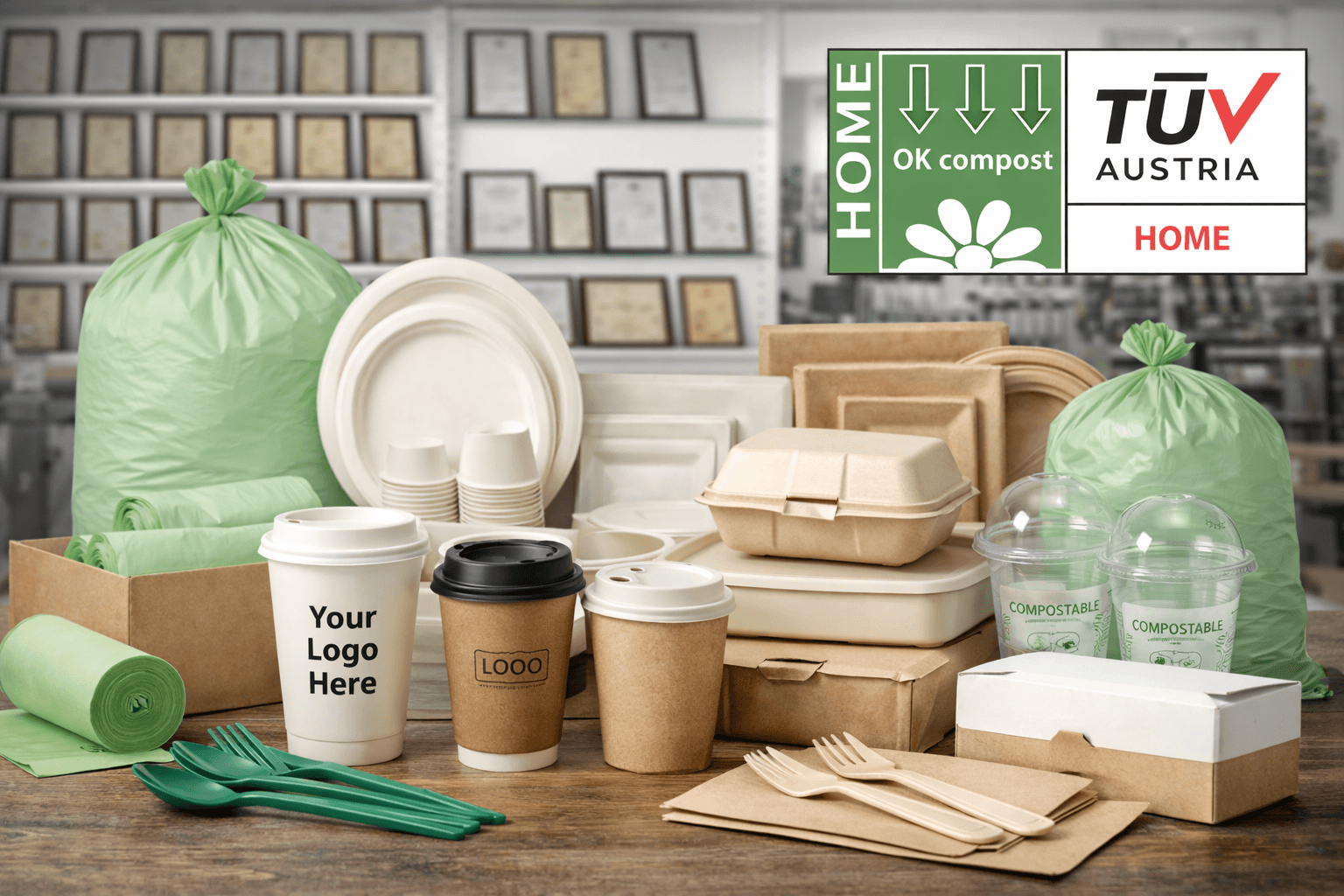
Certified Compostable Solutions for Businesses | AMS•COMPOSTABLE


The Compostable Vendor Selection Problem
For businesses under pressure to reduce plastic, the compostable packaging market can feel overwhelming.
Hundreds of suppliers claim to offer “eco-friendly,” “biodegradable,” or “plant-based” solutions. Product catalogs look similar. Pricing varies wildly. Certifications are inconsistently disclosed—if they’re disclosed at all.
For sustainability, procurement, and ESG (Environmental, Social, and Governance) leaders, the real question isn’t whether to move away from plastic. It’s this:
Which compostable partner can we trust long term—without introducing compliance risk, operational disruption, or reputational exposure?
Choosing the wrong supplier can lead to:
-Non-compliant materials entering the supply chain
-Greenwashing risk in ESG disclosures
-Costly re-sourcing when regulations change
-Packaging failures that erode internal buy-in
This is why compostable packaging should not be sourced like a commodity. It requires a partner with verified standards, scalable manufacturing, and a clear understanding of regulatory reality.
What Businesses Should Demand From a Compostable Partner
Before comparing suppliers, it’s important to establish evaluation criteria. High-performing organizations typically assess compostable partners across six non-negotiable dimensions.
✔ Verified Certifications
Compostable claims must be backed by recognized third-party standards (e.g., ASTM D6400/D6868, BPI). Anything less creates risk.
✔ Regulatory Readiness
Suppliers should understand current and emerging plastic regulations—not just sell products, but help businesses stay compliant across jurisdictions.
✔ Performance Parity With Plastic
Packaging must function under real-world conditions: heat, grease, moisture, transport, and storage.
✔ Supply Chain Reliability
Commercial buyers need consistent inventory, predictable lead times, and scalable production—not one-off solutions.
✔ Commercial Scalability
What works for a pilot must also work at enterprise or multi-location scale without quality drift.
✔ ESG & Reporting Support
Sustainability teams need documentation, certifications, and clarity to support internal reporting and external disclosures.
Only after setting these standards does it make sense to evaluate individual suppliers.
How AMS Compostable Meets—and Exceeds—These Criteria
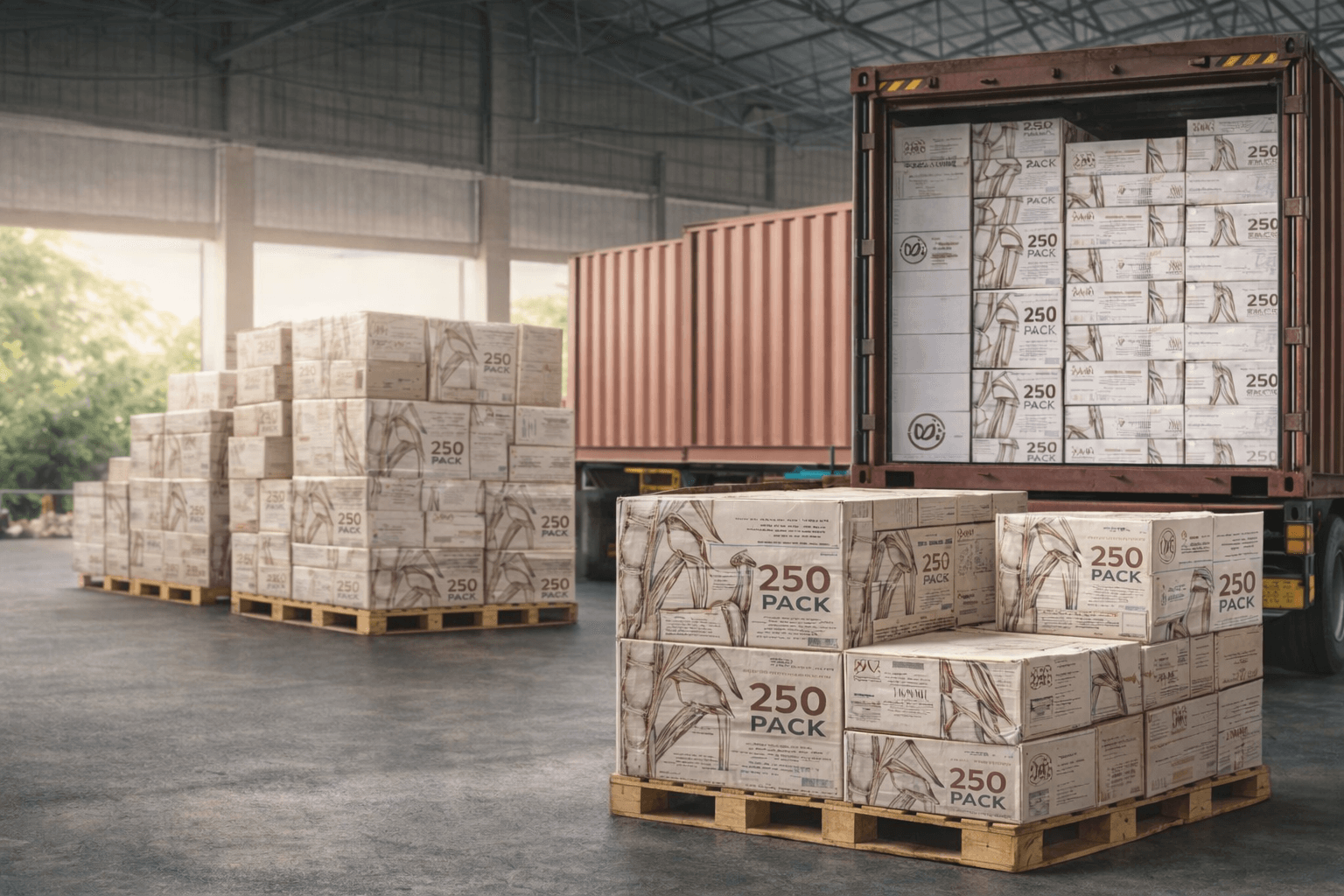
AMS•COMPOSTABLE is designed specifically for businesses that view compostable packaging as a long-term operational and compliance decision, not a branding exercise.
Certifications & Compliance Leadership
AMS•COMPOSTABLE focuses on certified compostable solutions, not loosely defined “eco” alternatives. Products are aligned with recognized compostability standards, supporting:
-Regulatory compliance
-Defensible ESG reporting
-Reduced greenwashing risk
This certification-first approach helps procurement and sustainability teams avoid ambiguity when materials are reviewed by legal or external auditors.
Material Performance & Product Integrity
Compostable packaging only succeeds if it performs like plastic where it matters. AMS•COMPOSTABLE works with proven materials such as PLA, bagasse, and plant-based fibers engineered for foodservice and commercial use.
The result is packaging designed to be drop-in compatible with existing operations—minimizing retraining, waste, and internal resistance.
Scalability for Growing and Enterprise Businesses
Many compostable suppliers serve niche or local demand. AMS Compostable is structured to support:
-Distributors and wholesalers
-Multi-location operators
-Brands with national or regional footprints
This scalability reduces the risk of supplier churn as sustainability initiatives expand.
Industry Expertise & Advisory Orientation
Rather than positioning compostable packaging as a one-size-fits-all solution, AMS•COMPOSTABLE operates with a consultative, education-driven philosophy.
This includes helping buyers understand:
-Which materials align with specific use cases
-How compostable packaging fits within waste management realities
-Where compostable solutions deliver the most impact first
For internal stakeholders, this expertise translates into clearer decision-making and stronger cross-functional alignment.
Risk Reduction for Procurement and ESG Teams
Ultimately, AMS•COMPOSTABLE’s value shows up in what it helps businesses avoid:
-Reputational risk from misleading claims
-Compliance gaps as regulations evolve
-Operational disruption from underperforming products
For teams measured on long-term outcomes, this risk mitigation is often more valuable than short-term cost savings.

AMS•COMPOSTABLE vs. “Typical” Compostable Suppliers
vs. Generic “Eco-Friendly” Suppliers
Many suppliers rely on vague environmental language without certification clarity. This shifts risk onto the buyer.
AMS•COMPOSTABLE prioritizes verified compostability, giving procurement and ESG teams documentation they can stand behind.
vs. Low-Cost Alternatives
Lower-priced compostable options often cut corners on material quality, certification scope, or supply reliability.
The hidden costs typically surface later as:
-Product failures
-Re-sourcing expenses
-Compliance issues
AMS•COMPOSTABLE competes on total value—not just unit price.
vs. In-House or Fragmented Sourcing
Managing multiple compostable vendors internally can strain procurement teams and introduce inconsistency.
Working with a specialized compostable partner simplifies vendor management while improving standardization across SKUs and locations.
Real-World Use Cases (Conceptual)
Food Brands Navigating Plastic Bans
A regional food brand facing new single-use plastic restrictions needs packaging that meets compliance standards across multiple states. Certified compostable packaging reduces regulatory uncertainty while preserving brand trust.
Enterprises Reporting ESG Metrics
An enterprise sustainability team requires verifiable data for ESG disclosures. Certified compostable materials provide documentation that withstands audit and stakeholder scrutiny.
Operations Teams Needing Drop-In Replacements
Operations leaders prioritize continuity. Compostable packaging that mirrors plastic performance enables sustainability adoption without operational disruption.
These scenarios illustrate why supplier selection—not just material choice—determines success.
Long-Term Value and ROI
Compostable packaging decisions should be evaluated through a total cost of ownership lens.
-Long-Term ROI Includes:
-Avoided compliance penalties
-Reduced future re-sourcing costs
-Stronger customer and stakeholder trust
-Alignment with evolving regulations
AMS•COMPOSTABLE’s focus on certified, scalable solutions helps businesses future-proof packaging strategies rather than react to each new regulation.
Who AMS•COMPOSTABLE Is Best For—and Who It’s Not
Best Fit For:
-Businesses prioritizing compliance and ESG credibility
-Distributors and multi-location operators
-Organizations seeking scalable, long-term solutions
-Procurement teams managing regulatory and reputational risk
May Not Be the Right Fit For:
-One-off promotional packaging needs
-Businesses seeking the lowest possible short-term price
-Organizations without access to composting infrastructure or plans
This qualification ensures alignment and sets realistic expectations—building trust before any conversation begins.
Professional Call to Action
For organizations actively evaluating compostable suppliers, the next step is often a structured review—not a sales pitch.
Assessing current materials, reviewing certifications, and understanding regulatory exposure can clarify whether certified compostable solutions are the right fit.
AMS•COMPOSTABLE provides resources and expertise to support that evaluation, helping decision-makers move forward with confidence rather than uncertainty.
Decision Summary
- Compostable packaging is a compliance and risk-management decision, not simply a sustainability initiative
- Verified certifications and supply-chain scalability matter more than environmental marketing claims
- AMS•COMPOSTABLE differentiates through certified standards, proven material performance, and enterprise-ready scale
- The right partner lowers total cost of ownership while reducing regulatory, operational, and reputational risk
For businesses investing in certified compostable solutions, the right vendor matters as much as the material—and the consequences reveal themselves over time.
Ready to Evaluate the Right Compostable Partner?
If your organization is actively assessing compostable packaging—or questioning whether current materials will stand up to regulatory, operational, and ESG scrutiny—the next step isn’t a quick product switch. It’s a structured evaluation.
Reviewing certifications, understanding material performance, and stress-testing supplier scalability now can prevent compliance risk, rework, and costly transitions later.
AMS•COMPOSTABLE works with sustainability, procurement, and operations teams to assess existing packaging, clarify compliance requirements, and determine whether certified compostable solutions are the right long-term fit.
For organizations that need confidence—not assumptions—the most productive next step is an informed conversation.